
Key takeaways
What matters before you keep reading
01
The BOM is the material and component source of truth inside a tech pack.
02
A useful apparel BOM separates fabrics, trims, labels, hardware, artwork, thread, packaging components, and material assumptions.
03
AI-generated BOM drafts are valuable when they make material assumptions visible for review instead of leaving blank rows.
Reader guide
Reader guide
A quick frame before the workflow details.
For
Designers, product developers, founders, sourcing teams, and apparel operators building or reviewing tech packs.
Read when
Best read before factory costing, material sourcing, or sample handoff.
You'll get
A practical BOM structure, common mistakes, and a review checklist for generated or manual tech packs.
On this page
Follow the article through the long read and keep your place.
On this page
5 sections
The bill of materials is where a tech pack tells the factory what the garment is made from.
If the BOM is weak, the factory has to guess about fabrics, trims, labels, hardware, artwork applications, thread, and packaging. That makes quotes less reliable and samples harder to compare.
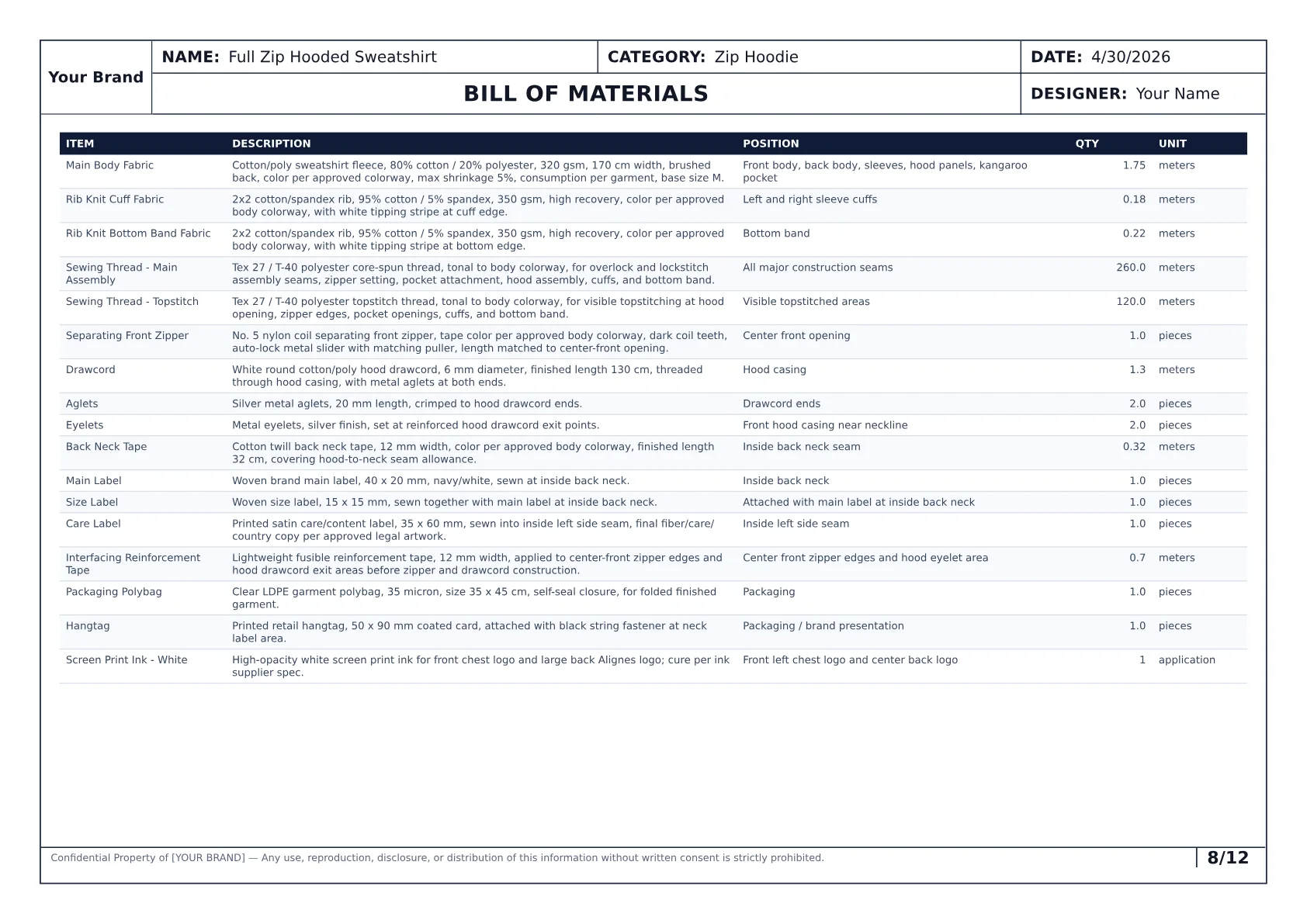
A populated BOM makes material assumptions visible. The team can review the draft before the factory sources, quotes, or samples against it.
What a BOM includes
An apparel BOM should separate the garment into components a factory can source, cost, and assemble.
Common BOM fields:
- component name,
- garment location,
- material type,
- composition,
- weight or specification,
- color,
- supplier/source if already selected,
- quantity or usage note,
- artwork or label method,
- comments or review notes,
- comments for pending decisions.
Not every project has every field ready at the first sample stage. That is fine. The key is to mark what is known and what is pending.
Apparel BOM sections
| BOM section | Examples | Why it matters |
|---|---|---|
| Main fabric | Fleece, jersey, denim, woven shell, swim fabric | Drives cost, fit, drape, construction, and sourcing |
| Secondary fabric | Lining, pocketing, rib, mesh, facing | Prevents hidden substitutions in smaller garment areas |
| Trims | Zippers, buttons, drawcords, snaps, elastic | Affects function, durability, and quote accuracy |
| Labels | Main label, size label, care label, hangtag | Keeps branding and compliance visible |
| Artwork | Print, embroidery, patch, heat transfer | Connects placement and method to the garment |
| Thread and stitching | Thread color, stitch type, topstitching | Supports construction and visual consistency |
| Packaging | Polybag, carton, folding, inserts | Useful when the handoff moves closer to production |
BOM mistakes that slow factories down
The most common BOM mistake is writing a material category instead of a usable component.
Weak BOM notes:
- "cotton fabric",
- "zipper",
- "label",
- "print",
- "thread".
Better BOM notes explain where the component belongs and what is known:
- body shell fabric, fleece, black, composition pending,
- center front zipper, metal tone pending, full length,
- main neck label, woven, artwork file pending,
- left chest print, white, placement shown on callout page.
Checklist
BOM review checklist
Use this before sending a tech pack for costing or sampling.
Every visible component is listed
Main fabric, secondary materials, trims, labels, artwork, thread, and packaging are not hidden in loose notes.
Pending decisions are labeled
Missing source, composition, color, or artwork details are visible instead of implied as final.
BOM matches callouts
Materials and trims named in callouts also appear in the BOM.
BOM matches colorways
Variant-specific colors and artwork do not contradict the colorway pages.
Factory can quote against it
The manufacturer has enough material information to ask precise questions or provide a more realistic estimate.
How the BOM connects to the rest of the tech pack
The BOM should not live in isolation.
It should agree with:
- callouts,
- construction details,
- colorways,
- artwork pages,
- labels,
- measurement and fit notes where material affects stretch or drape,
- current export context.
If the callout says metal eyelets but the BOM does not list eyelets, the factory has to decide whether that was an omission or a design change.
Why generated BOM drafts help
A blank BOM template forces the team to remember every component manually. A generated first draft can inspect garment references and notes, then create a populated starting point.
That does not make every material final. It makes the assumptions visible.
Draft to review
Stronger BOM workflow
What changes across the process
- 01
Step 01
Read the garment inputs
Images, sketches, notes, artwork direction, and trim references show what components need to be listed.
- 02
Step 02
Generate the BOM draft
The draft separates fabrics, trims, labels, hardware, artwork, thread, and pending fields.
- 03
Step 03
Review material decisions
The team confirms composition, color, source details if needed, and final material decisions before factory handoff.
BOM generation is useful when it surfaces material and trim assumptions for review, not when it pretends pending sourcing choices are final.
Process showing garment references becoming a generated bill of materials
In practice
See BOM inside a generated tech pack
The hoodie example includes a populated BOM alongside measurements, callouts, construction details, colorways, artwork, and export-ready pages.
View the generated hoodie tech packFAQ
Common questions, answered clearly.
BOM means bill of materials. It is the structured list of materials, trims, labels, hardware, artwork applications, thread, packaging, and sourcing notes needed to make the garment.
Next step
Generate BOM structure with the rest of the pack
Styneo generates tech pack drafts that include BOM, measurements, construction details, callouts, colorways, artwork, and export-ready pages from garment references and notes.